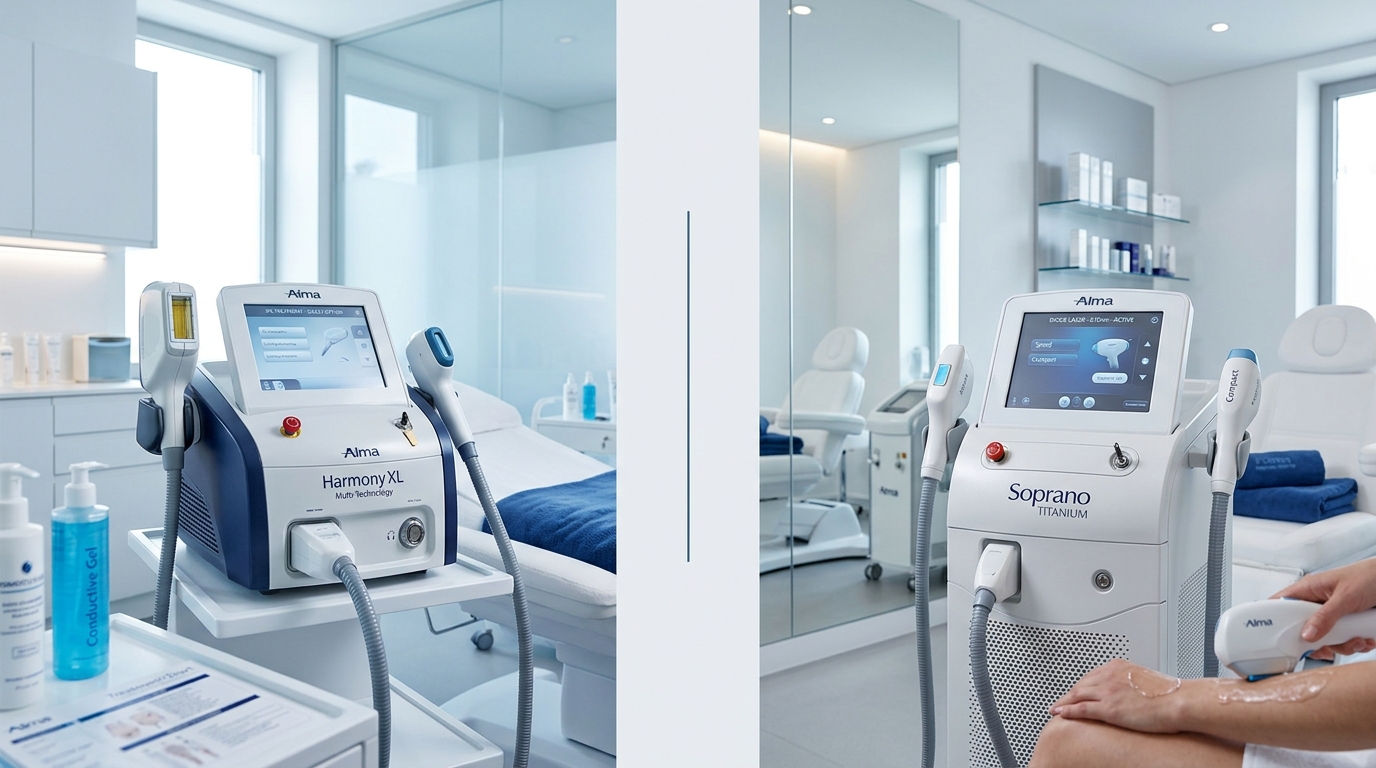
One machine fires a single, focused wavelength straight into the follicle. The other scatters a broad spectrum of light across the skin and treats several things at once. That physics difference decides demand and how your clinic performs.
- A diode laser is the stronger laser hair removal machine. It is safe across every Fitzpatrick type when carrying a 1064 nm wavelength.
- IPL is the more versatile skin platform. It covers pigmentation, vascular concerns, acne, photo-rejuvenation and hair reduction on lighter skin.
Clinics building volume around hair removal buy diode. Clinics building a broad skin menu buy IPL. Busy clinics eventually own both.
What Is Actually Happening Inside Each Device?
A diode laser emits one wavelength in parallel lines. The range typically includes:
- 755 nm
- 808 nm
- 940 nm
- 1064 nm
The energy travels to a set depth and is absorbed by follicular melanin. It doesn’t scatter, ensuring maximum absorption. Contact cooling protects the epidermis while the bulb and bulge take the heat.
IPL uses a flashlamp producing polychromatic light. Its range is from 500 to 1200 nm. The rays are shaped by cut-off filters that block the unrequired shorter wavelengths. The light is not parallel, so it spreads as it enters tissue. That spread is a limitation for follicle targeting. This is why IPL offers an advantage for treating broad surface concerns.
Which Handles More Skin Types Safely?
The diode laser, without much debate. Melanin absorption is the deciding factor. IPL’s broad spectrum delivers energy that epidermal melanin absorbs readily. This raises burn and hyperpigmentation risk on Fitzpatrick IV through VI.
Practical positions for each:
- IPL performs reliably on Fitzpatrick I through III with dark, coarse hair
- Diode at 808 nm covers I through IV comfortably
- Diode platforms including 1064 nm treat V and VI safely, which IPL cannot match
- Tanned clients are a contraindication for IPL far more often than for diode
That difference determines how many enquiries your front desk turns away.
Which Produces Better Hair Reduction Per Session?
Diode, on both permanence and speed. Diode systems achieve stronger long-term follicle destruction, while IPL delivers reduction needing more frequent maintenance. Clients typically need six to eight diode sessions versus eight to twelve IPL sessions.
A high-power diode with a large spot and in-motion technique clears full legs in 20 to 30 minutes, whereas IPL runs longer and demands more careful parameter selection.
Which Earns More Per Treatment Room?
This depends entirely on your menu. IPL generates revenue across several services from one purchase:
- Photofacial and general photo-rejuvenation
- Rosacea and diffuse vascular redness
- Sun damage, freckling, and pigmented lesions
- Active acne management
- Hair reduction on suitable skin types
A diode laser does one job at volume. Hair removal packages are among the most reliable recurring revenue in aesthetics, with clients buying six sessions upfront and returning for maintenance for years.
Clinics running both fill schedules more evenly, since IPL absorbs skin enquiries when hair removal slots are booked out.
What Does Each Cost to Buy and Run?
Purchase price tells half the story. IPL platforms generally run $5,000 to $25,000, while professional diode systems sit between $25,000 and $60,000, with premium branded units higher.
Ongoing costs differ in structure:
- IPL flashlamps are consumables needing replacement, commonly every 50,000 to 100,000 shots, plus filter replacement over time
- Diode bars carry far longer rated lifespans, frequently 20 to 100 million shots depending on build quality
- Service contracts apply to both, typically $3,000 to $8,000 annually
- Training requirements are heavier for IPL, since parameter selection is more operator-dependent
Calculate cost per shot rather than comparing sticker prices. A cheaper IPL with frequent lamp replacement can cost more over five years than a diode platform bought at twice the price.
Which Should Your Clinic Buy First?
Answer three questions honestly: what share of your enquiries are hair removal, what Fitzpatrick range your local market covers, and how many rooms you can keep busy.
Hair removal above roughly 40 percent of enquiries points to diode, particularly with a diverse client base. A skin-focused clinic serving lighter skin types gets more menu value from IPL. Both devices require a Health Canada Medical Device Licence. Verify the licence number covers the exact model and configuration you are quoted before any deposit moves.
Frequently Asked Questions About IPL and Diode
- Can IPL Remove Hair Permanently?
IPL achieves long-term hair reduction rather than permanent removal. Most clients need ongoing maintenance sessions to hold results.
- Is a Diode Laser Safe for Dark Skin?
Yes, when the platform includes a 1064 nm Nd:YAG wavelength. It passes through epidermal melanin with minimal absorption.
- How Many Sessions Does Each Require?
Diode typically needs six to eight sessions, IPL eight to twelve, spaced four to six weeks apart.
- Can One Machine Do Both Jobs?
Multi-wavelength diode platforms handle some pigmented and vascular work, though IPL remains stronger for broad photo-rejuvenation.
- Which is More Profitable for a New Clinic?
Diode, if hair removal drives bookings. IPL, if you need one machine covering several service lines.
IPL vs Diode Laser at a Glance
| IPL | Diode Laser | |
| Light Source | Broadband, 500 to 1200 nm | Single wavelength, 755 to 1064 nm |
| Beam | Scattered, non-coherent | Coherent and collimated |
| Skin Types | Fitzpatrick I to III | I to VI with 1064 nm |
| Sessions Needed | 8 to 12 | 6 to 8 |
| Speed, Full Legs | 1 Hour | 30 to 45 minutes |
| Other Indications | Pigmentation, vascular, acne, rejuvenation | Primarily hair, some pigment and vascular |
| Consumables | Flashlamps and filters | Diode bars, long lifespan |
| Purchase Price | $5,000 to $25,000 | $25,000 to $60,000 |
| Operator Dependence | High | Moderate |
Talk to Incredible Laser about which platform suits your client base and booking mix.